Date of the decision: 19 February 2021
Country: Spain
Jurisdiction: Committee on Economic, Social and Cultural Rights
English
Date of the decision: 19 February 2021
Country: Spain
Jurisdiction: Committee on Economic, Social and Cultural Rights
The problem of "financialization" is a threat awaiting the largest Polish cities, both due to the accumulation of apartments as capital investment, and for the needs of tourism. In the near future, this threat could become as serious a problem as the infamous re-privatization, warn Maria J. Aldanas and Jakub Wilczek of FEANTSA.
For the first time, Housing Rights Watch and the Housing Solutions platform organized a joint webinar on the theme "Rethinking rent control in Europe".
On the 14th of September 2021, a report was presented on Monitoring adequate housing in Ireland by the ESRI and the Irish Human Rights and Equality Commission (IHREC).

This training course is part of a series of capacity building activities addressed mainly to FEANTSA members in the framework of our Annual Programme.
Housing Rights Watch organised this online event together with Ricardo Ferreira and Ana Martins, AMI, Fundação de Assistência Médica Internacional.
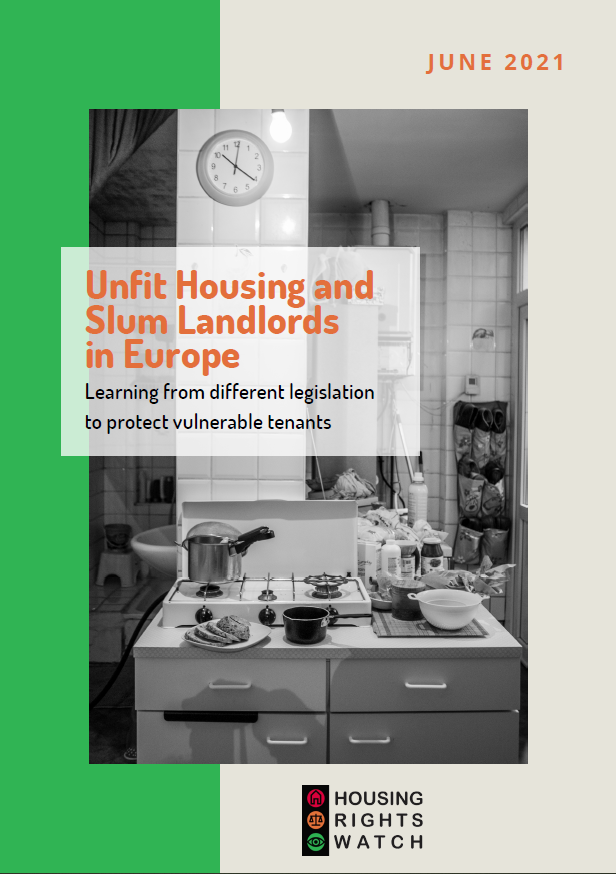
Study on unfit housing in the EU: learning from different legislation to protect vulnerable tenants. (EN)
Download it here.
The Abbé Pierre Foundation and FEANTSA published their Sixth Overview of Housing Exclusion in Europe on 6 May 2021. This latest report focuses on young people, who are worse affected by housing exclusion than other groups, especially when they are poor, which was the case even before the pandemic took hold. The report also takes stock of the wave of poverty that has engulfed Europe more than a year after the pandemic began. Difficult housing conditions have a negative impact on young people's pathway to independence.
Susheela Math
Legal Officer, Open Society Justice Initiative
Thousands of people across Denmark face eviction from their homes under the country’s “Ghetto Package,” which seeks to “eradicate” “ghettos” by 2030. The State distinguishes “ghettos” from other areas with the same socio-economic factors on the basis that the majority of residents are of what it calls “non-Western background.”